How hard is it?
Let’s not lie here: yes, hardware is hard. But the reasons behind that “yes” are far more interesting than the answer itself.
When you build hardware, you’re not just dealing with pros and cons. You’re entering an entire universe of chaos, logistics, and emotional instability. People perceive hardware as hard because it is. It takes more time, more money, more skills, and every mistake comes with a real, physical cost. Blow something in software and you can ship a patch an hour later. Blow something in hardware and you’ve just lost months of progress and thousands of dollars.
My answer is : Very.
And before anyone gets offended: I am not a software expert, so yes, this is biased.
Why I’m in bed with hardware
Let me start with the real reason I love hardware: physical products just hit different.
It’s why I obsessed over Lego as a kid, why I studied engineering, why I’m building eNOugh, and why I’ll probably build physical products until the day I die. The reason is stupidly simple: hardware is real. You experience it in 5D. You hold it, break it, improve it. It lives in the world, not behind a glowing rectangle.
When someone sees a prototype for the first time. Their eyes widen, they poke it, they ask a million questions. They love it, hate it, misunderstand it, obsess over it.
That emotional reaction? You don’t get that from an app. And tell me honestly… do you get more excited downloading a new app… or when your Amazon delivery hits the door?
I know my answer.
The challenges…
If your objective is to spin something up quickly, stay far away from hardware. Nowadays, with tools such as Lovable, GPT, Undivided, Durable, and every AI copilot available to all, you can build an MVP in a weekend.
Hardware equivalent? If it exists, someone please DM me immediately.
Hardware is a collection of skills that, unfortunately, do not come packaged in a single tutorial. You need electronics, mechanics, firmware, sourcing, manufacturing, testing, certifications… the whole circus. This is not a one-person show unless your name is Tony Stark.
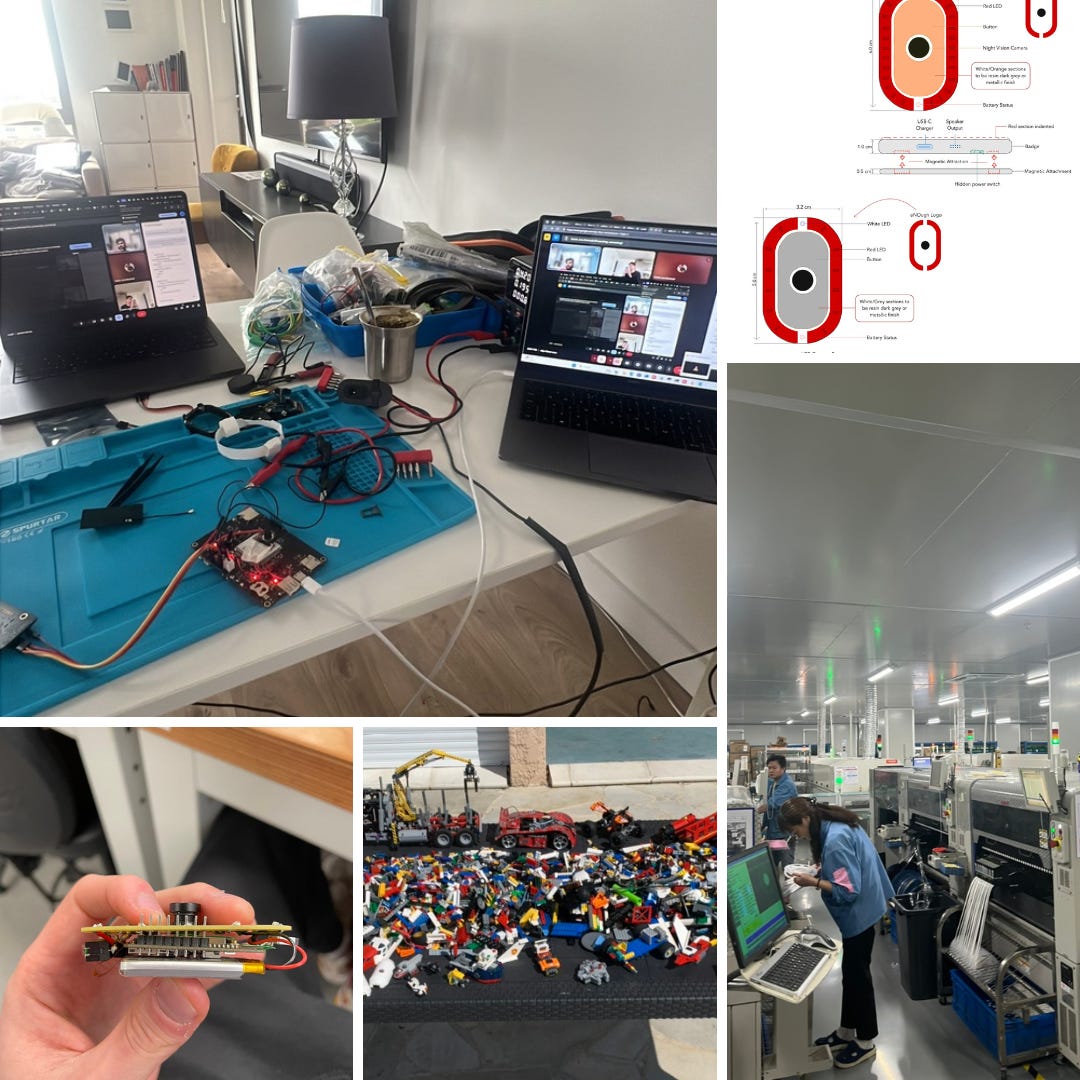
The process itself is long, messy, and humbling. It starts with an idea, which becomes requirements. You hack together a shitty prototype using dev boards. If that doesn’t explode, you design a real PCB. Then an enclosure. Then you realise nothing fits. Then you redesign everything. Eventually you complete your PoC (proof of concept) and enter the acronym gauntlet: EVT, DVT, PVT … each stage revealing new problems you didn’t know existed. Meanwhile, you ALSO may need an app, a backend server, packaging, manuals, lab certifications, and a supply chain that somehow delivers your product on time.
And all of this has to happen while you pray you don’t go bankrupt. Because, to make things even more entertaining, hardware is expensive. You need time, money, and then more money for the mistakes you will inevitably make. Investors aren’t always excited either; like many founders, they avoid hardware at all costs. And honestly, that’s fair… the risks are real. And even when you find someone crazy enough to invest, you still face the challenge of gathering “market validation” with a prototype that barely holds itself together.
So… Why do it at all?
Now that I’ve traumatised everyone, let’s talk about the good part: hardware is freaking fun and has its advantages.
First: it’s hard.
And that’s a good thing. People fear it. That means fewer competitors come to play. Even big firms can’t move fast in hardware, just look at OpenAI estimating two years for a physical device.
Hardware is wildly defensible too. You can patent it, register the design, protect the tech stack. And yes, China can copy anything, but they usually copy once you’ve already sold millions. And I’ve seen hundreds of Oura-ring lookalikes in China… but barely anyone has heard of those. Software is (in my humble opinion) wayyy easier to copy.
Then there’s the financial magic. Platforms like Indiegogo and Kickstarter let you pre-sell your product before manufacturing, collect the funds, and use that to build. If you fail, money goes back to users, but the campaign itself can unlock investment or demand.
And consumers? They get that physical products cost money. There’s no “software should be free” narrative. Margins can be excellent if you’re thoughtful in your design and supply chain.
The Magic
Hardware is hard. It’s long. It comes with headaches you don’t get in any other industry. But the journey? It’s addictive.
Every stage feels like levelling up: idea → CAD → 3D print → PoC → EVT → DVT → PVT → etc.
And throughout the whole process, you imagine the moment your device ends up in someone’s hands… someone using something you built to solve a real problem in their real life.
That feeling is pure dopamine. It’s why I chose this path. It’s what gets me out of bed.
It’s why I’m still in love with hardware, even when it fries my brain.