

Why is Shenzhen so special
Over the past year, I’ve ended up in Shenzhen four times. And I’m going back in two weeks.
It’s definitely not for the food. As a Latino, I struggle hard with Chinese cuisine. But China has what the rest of the world doesn’t. Speed. Knowledge. Factories. A shit tonne of them. If you’re building any kind of hardware, that is where you have to be.
And I’m not the only one. I’ve met Argentinians manufacturing LED screens, French people importing phone accessories, Germans developing smart AI glasses. Shenzhen is a hub for anything that has a battery in it.
Now I’m writing this post because I’ve been asked too many times: how the hell did you manage to deal with China your first time? So…
The first time
Initially, I debated even going… what’s the fuzz all about, is it really worth it, do I have the time or the money to go? All my engineering friends were telling me it was useless, that video calls were enough. But the truth is that those friends, even though I love them, had never been. That’s like telling someone a restaurant is amazing, without ever going there.
But I was reaching a dead end with product development for eNOugh, so I took my courage and flew to Shenzhen. Alone. No contacts. No friends. Only me, myself and my suitcase.
I was expecting to be totally lost and worried the whole trip would be useless. But thank god that was a terrible judgement. I learned the hard way that until you physically go somewhere, you are just naively oblivious to what’s actually possible. That one week in Shenzhen unlocked what months of work in the EU couldn’t, and it opened up a multitude of opportunities for making our product.
The essentials
Before anything, China is China. It’s not Europe, it’s not America, it’s China…
First, your Western apps don’t work in China. That Great Firewall is a pain in the ass. No Google, no Instagram, no WhatsApp. Nada. You land and your phone becomes a very expensive brick. Here’s what you actually need to survive. Alipay: your credit card is just a piece of plastic there. DiDi: that’s your Uber. WeChat: that’s your WhatsApp. And a working VPN: I use Surfshark or my French eSIM with a built-in VPN, because without one, you’re cut off from everything you know.
Secondly, make sure you do your business in your hotel toilets… I can’t squat for shit and there’s no way I’ll attempt doing my business on a hole in the ground.
Finally, get a decent translator app too, and communicate with simple words as I feel English to Chinese translation has not been properly solved. Download English and Chinese offline as well, since your phone will lag with the VPN. Kind of an embarrassing fact, but after spending a cumulative three months in China, I’ve only learned four words: thank you (xie xie), not spicy (bu la), hello (ni hao), and recently, yes (dui). At this rate, I’ll be fluent by 2067. So I gave up trying.
The China you don’t expect
Let me challenge some assumptions.
I expected China to be strict. And it is, in a way. Cameras are literally EVERYWHERE. But speaking with locals, you realise you can do whatever you want as long as you don’t play with politics and no police is watching. God damn, I’ve even had shots with security guards. The image we have in the West? Way more nuanced than that.
And the beauty of Shenzhen genuinely caught me off guard. First, it’s safe. You can walk around with your phone in your hand without being scared of it being stolen. Then you get every street perfectly clean, with all vehicles being electric. You can stand in the middle of Shenzhen and hear no traffic. And finally, it does feel like a futuristic tropical place… trees everywhere, skyscrapers standing out of the vegetation, high humidity and heat.
Oh, and Huaqiangbei. Oh, I love that place. Imagine if Amazon had a physical store, but everything was SO much cheaper. Suitcases for $15. Drones for $20. SD cards 40% cheaper. Mini leather phone wallets for $2. It’s heaven for anyone who loves electronics and gadgets.
What I still struggle with
The food almost broke me.
Chinese food in the West is NOT Chinese food in China. They fry bones as a dish. The menus are picture-based, and I’m terrible at judging what I’m looking at. Translating doesn’t help either… “beef temptation” or “nail powder starch noodle” could mean absolutely anything. Ordering food felt like defusing a bomb with Google Translate as your only guide.
I solved that issue the hard way… a good Shake Shack and McDonald’s… Don’t judge me.
Another thing: when someone says “okay” in China, it doesn’t mean they 100% understood you. It might mean 20%. Or 50%. And you realise too late. I once accidentally ordered three bubble teas when I just wanted one. I spent the rest of the day going for a wee.
One more practical note: pick a 4 or 5 star hotel. They’re still cheaper than rent in London. I learned the hard way that lower-end hotels are just not for me. They allow smoking inside, come with… unexpected amenities (had some sex toys displayed on my desk once), and have WiFi so poor that any call through a VPN becomes not unbearable, but impossible.
The work ethic
One thing I can’t stop thinking about is the people in China.
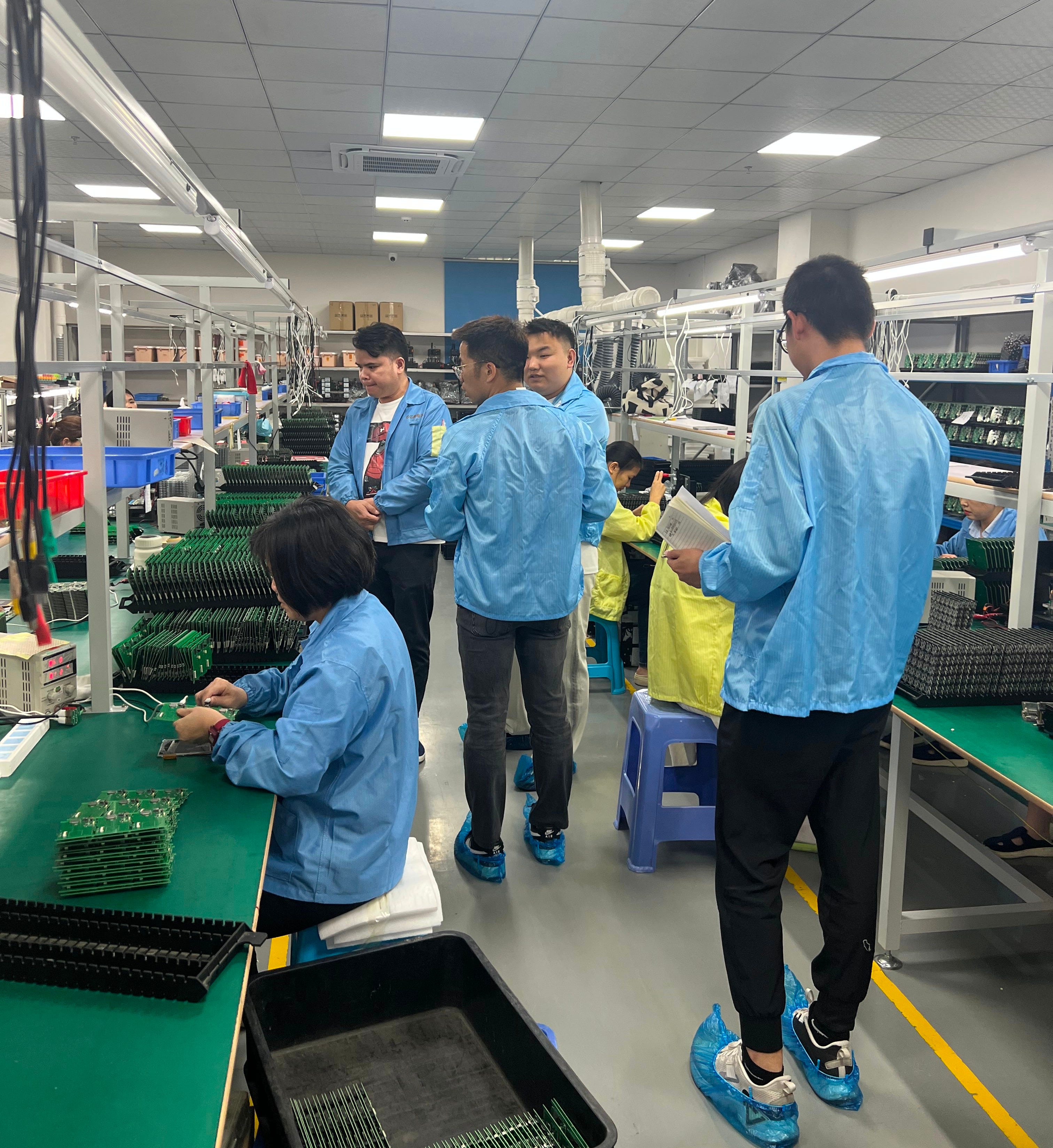
Inside the factories, they do the exact same task, again and again, for 12 hours straight. Lunch break, a nap, a cigarette, and back to it. If hardware development were a video game, these people would be the bots that are always ready to play. Their execution is unmatched.
But it’s not just the factories. The entire ecosystem moves at a speed that makes Europe feel like it’s buffering. You send a message at 11pm and get a detailed reply by midnight. You ask for a prototype and it’s in your hands within days, not weeks. And when someone can’t help you, they’ll know someone who can. And that someone will message you within the hour.
There’s no “let me circle back” or “let’s schedule a call next Thursday.” It’s just… done. The collaboration is relentless. And once you experience that pace, going back to Western timelines feels physically painful.
Though I’ll say honestly: I don’t think that grind is great for creativity. But for getting things built? Nothing comes close.
Just go
For those building a hardware product, just go.
Here’s what I’ll tell you: you will one day end up in Shenzhen and regret you didn’t go sooner. Mark my words. So go as soon as you can. At the very least, get yourself an idea of what’s possible. Don’t let that question of “should I go or not” haunt you.
For those reading this because (I hope) they enjoy it: I can promise you that travelling to China is an experience of a lifetime, and that life there is far cheaper than here, so the only investment is a return flight.
Thanks very interesting. I’m planning on going in a couple of months.