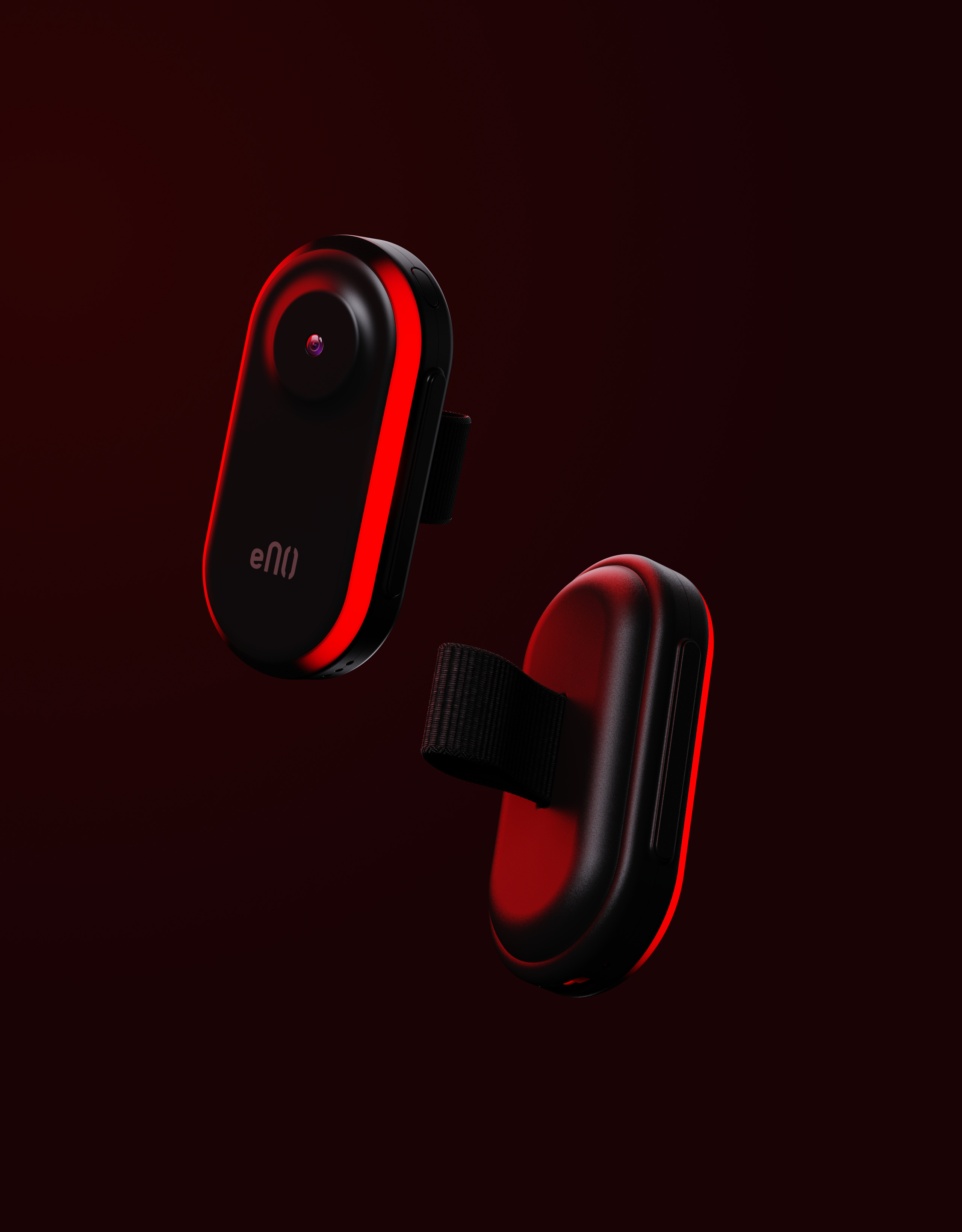
In Part 1, I focused on the object: the constraints, the challenges, and the decisions that shaped the eNO badge as a physical product.
You can find part one of this post here: The upbringing of the eNO badge - part 1
Part 2 is about how different stakeholders impact decisions and how we remain in check as founders regarding design directions.
It’s all about listening
Rather than relying on our own assumptions or playing guessing games, we deliberately stepped back and let those who understand safety best guide us: criminal psychologists, university researchers, people who work in and around prisons, and, just as importantly, users themselves.
We spent months collecting information, sitting down with small focus groups, calling friends, sending out forms, and brainstorming over feedback. My co-founder Ina alone must have spoken to more than a thousand people at this point. I’ve lost track of how many sessions she ran with complete strangers. But this work was massively valuable, because it taught us how our future users define safety. What makes them feel protected? What triggers anxiety? What emotions a safety product evokes the moment they see it, touch it, or wear it.
Every conversation followed a basic Mom Test approach: no leading questions, no validation-seeking. This gave us access to genuinely honest answers, and the facial expressions that came with them. It’s unfortunately very obvious when someone does not like something and gives you the “EWW” face.
In parallel, we looked at the product from the opposite perspective. How it would be perceived by someone with bad intentions. What stands out and catches attention. What blends in and goes unnoticed. What signals value, vulnerability, or awareness. While you can imagine how difficult it would be to simply find criminals or show up in a prison to talk to them… but criminologist, police officers and defence experts did that job for us.
Bringing the user and criminal perspectives together was challenging. Their behavioural psychology doesn’t exactly align… What a surprise, right?
Our role as designers, then, was to take all of these inputs and synthesise them into a clear design direction, to find the narrow path where discretion, reassurance, and safety effectiveness could coexist.
This ultimately translated into avoiding aggressive shapes, sharp edges, and visual cues associated with fear. Instead, we leaned into a smooth design, round forms, and visual purity across every element.
Our north star was simple: the product should feel so natural in daily life that it becomes an extension of the person, almost forgotten when worn, while still feeling empowering and doing its job when it’s needed most.
When founder taste is in play
As founders, and as human beings, we all have taste. Strong opinions. A personal idea of what “good” looks like.
In our case, that was even harder because there were two of us making these design decisions. Ina and I have very different design sensibilities. What sometimes felt elegant to one of us felt absolutely ugly to the other. And early on, it’s tempting to treat your own gut feeling as correctness, and to assume that your own confidence means you’re right.
It just doesn’t.
“I like it” is one of the most dangerous arguments in design. Not because taste doesn’t matter, but because it’s personal. And a safety product can’t afford to be a personal statement.
I’ll be the first to admit that I can be stubborn and convinced I know best. But I constantly remind myself that I’m not the only potential user. We’re not designing for Ina and I. We’re designing for millions of people we’ll never meet.
Whenever opinions diverged internally, we forced ourselves back to the same question: what does the user actually wand and need? If you don’t do that, you lose.
When user taste is in play
On top of that, I believe that, to some extent, users don’t always know what they need. At least not yet. Truly new products often require education before preference. Steve Jobs put it well: “It’s really hard to design products by focus groups. A lot of times, people don’t know what they want until you show it to them.”
The balance, then, is delicate. Listening without becoming too reactive. Leading without becoming dogmatic. A fine line sometimes hard to stay on.
Testing my gut feelings
I won’t pretend I’m neutral when it comes to design. That would be a straight lie, and the truth is that NO ONE is. But I do love to put myself in other people’s shoes, thinking about how a design might be perceived, how someone might react to a certain curvature, a texture, or a colour.
I’m always working toward what I genuinely believe will be liked by the masses. In other words, yes… it’s gut feeling. An intuition built from observation, empathy, repetition, and past experience.
Of course, it is biased. It naturally pulls you toward what you personally like. That’s why it’s our responsibility to test assumptions directly with users.
Whenever something feels right to me, I try to remove myself from the equation. I’ll share a few images of a design without context, explanation, or justification. And I’ll listen. Only then do I may introduce context, explanation, and intent. With a safety wearable, it’s often interesting to see how opinions evolve once people understand the purpose behind certain design choices. When others’ feedback mirrors my intuition, that’s when I learn to trust it.
That’s how I’ve built my gut feeling over time. Every correct instinct strengthens my internal model. Every wrong one puts me back in check.
And yes, there have been many moments when what users wanted was not what I thought was right. In those cases, you have to let go. You understand why they want it, and you move forward with it.
Designing a safety product leaves no room for ego. The stakes are too high. We don’t design for ourselves. We design for the people who will rely on the product when it matters most.
The eNO badge
Below is the eNO badge. It’s still in the works, but soon to appear out there, in actual streets, on actual people.
To close this post, one thing feels worth repeating: don’t try to win design debates. That’s a trap we all fall into someday. It’s easy to obsess over details, chase perfection, and end up building something you love.
But when your goal is to reach millions, your taste can’t be the north star. Sometimes you have to move forward with choices you don’t fully agree with. Sometimes you’re wrong. That’s part of building real products.
Protect the core truth of what you’re building. Let users and experts decide when your taste needs to step aside.
That’s how things actually make it into the world.